How to Study for Finals: A Plan Built on the Research
On this page
- What is the best way to study for finals?
- How far ahead should you start studying for finals?
- How do you make a finals study plan?
- What does a finals plan look like for three exams?
- Why is cramming a bad plan?
- Is rereading your notes a good way to study for finals?
- How do you study several subjects at once?
- Should you pull an all-nighter before a final?
- What should you do the day before a final?
- How do you turn your notes into questions fast?
- How to study for finals in Memrize
- Sources
- Questions students ask
How to study for finals starts with a calendar, not a textbook. Write down every exam date, work backward, and give each topic at least two closed-book sessions a few days apart. Of ten techniques students commonly use, a large review rated only practice testing and spaced practice as high utility, and rated rereading and highlighting low. Then protect your sleep: in a diary study of 535 high school students, studying extra at the expense of sleep was followed by more academic problems the next day.
Key takeaways
- Test yourself on the material instead of rereading it. Practice testing and spaced practice were the two techniques rated highest in a review of ten.
- Start early and spread out your sessions. The further away the exam, the longer the gap between reviews can be.
- Mix subjects and problem types within a session. Shuffled practice beat blocked practice a week later in a math study.
- Cramming feels as if it works. In one flashcard study, spacing beat massing for 90% of students, yet 72% thought massing had worked better.
- Do not trade sleep for extra study hours. The students who did had more trouble the next day.
What is the best way to study for finals?
Use the two techniques with the strongest evidence behind them: practice testing and distributed practice. Practice testing means answering questions from memory before you look. Distributed practice means spreading that work over days or weeks.
In 2013, John Dunlosky and colleagues reviewed ten techniques students commonly use. Practice testing and distributed practice were the only two rated high utility, because they helped across many kinds of material, tests and learners. Summarizing, highlighting and rereading, which are what most students actually do, were rated low.
The practical reading is simple. Closed-book questions, spread over several days, beat another pass through your notes. Everything else in this guide is a way to make that easy to do when you have four exams and not much time: a plan, a way to mix your subjects, and a way to get questions out of your notes quickly.
How far ahead should you start studying for finals?
As early as your schedule allows, and the further away the exam, the wider the gaps between your reviews can be.
Cepeda and colleagues pooled 839 assessments of spacing from 317 experiments in 184 articles. Their analysis found that the gap between study sessions and the delay before the final test work together. The gap that gave the best memory grew as the delay until the test grew. A review gap that is ideal for a test tomorrow is too short for a test in a month.
For you, that means starting early has a payoff beyond having more hours. It lets you leave longer gaps, and longer gaps are what make each recall effortful and useful. If you have a few days, review each topic every day or two. If you have weeks, you can leave several days between visits to the same topic. If you are already short on time, the plan below still works. It just has fewer, closer visits.
How do you make a finals study plan?
A plan only has to answer one question each day: what am I testing myself on today? This is a method you can set up in twenty minutes.
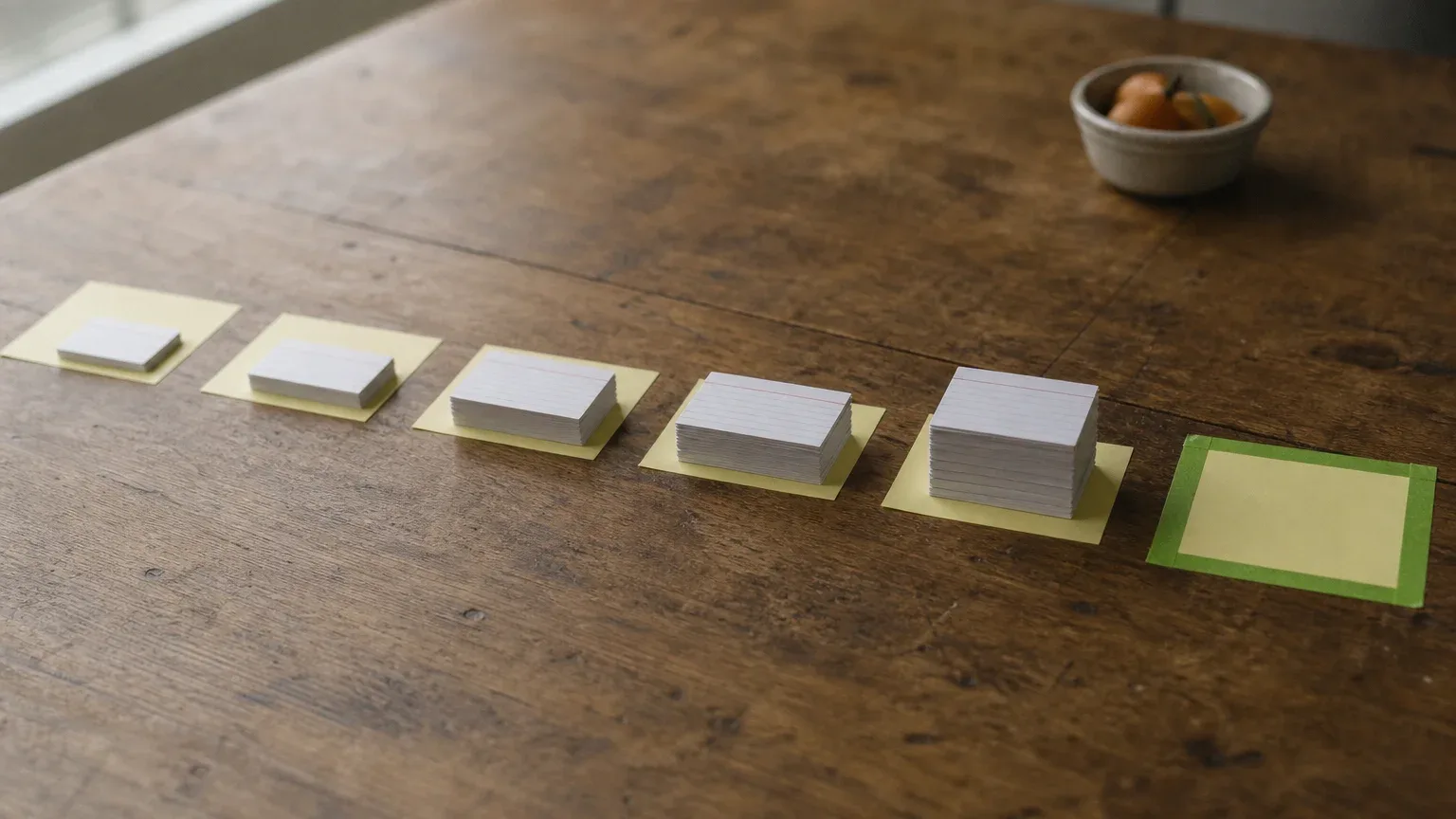
- List every exam with its date, and note what each one covers. Include open-book and take-home exams, since they still need recall.
- Count the days left and work backward. The exam that comes first gets its topics started first. Do not give each subject a block of days. Give each subject a little time on most days.
- Split each subject into topics small enough for one session, such as one chapter, one lecture or one problem type.
- Schedule each topic at least twice before its exam, with a gap between visits. The second visit is the one that shows what stuck.
- Start each session with a blank page. Write what you remember about the topic before you open anything. Blurting takes five minutes and shows you what to work on.
- End each session by writing tomorrow’s questions from what you missed.
- Leave one lighter day before each exam for a final pass through your misses, not new material.
What does a finals plan look like for three exams?
Here is the method above applied to a common case: biology on day 8, history on day 10 and chemistry on day 13, each split into four topics, and at most three sessions of 30 to 40 minutes a day.
| Day | Sessions |
|---|---|
| 1 | Biology 1, History 1, Chemistry 1 |
| 2 | Biology 2, History 2, Chemistry 2 |
| 3 | Biology 3, Biology 1 again, History 3 |
| 4 | Biology 4, Biology 2 again, Chemistry 3 |
| 5 | Biology 3 again, History 1 again, History 4 |
| 6 | Biology 4 again, History 2 again, Chemistry 4 |
| 7 | Biology misses only, History 3 again |
| 8 | Biology exam. Chemistry 1 again |
| 9 | History misses only, History 4 again |
| 10 | History exam. Chemistry 2 again |
| 11 | Chemistry 3 again, Chemistry 4 again |
| 12 | Chemistry misses only |
| 13 | Chemistry exam |
Every topic gets two visits before its exam, at least two days apart. No day is one subject from start to finish, and each exam has a light day before it. The later the exam, the longer its topics wait for their second visit, which is the spacing research put on a calendar. Swap in your own dates and topics and keep those three rules.
Why is cramming a bad plan?
Cramming does produce something. It just does not last, and it is a poor use of the same hours.
Nate Kornell ran three experiments in which students learned word pairs from flashcards, either in one big sitting or spread out. Spacing was more effective than massing for 90% of the participants. Yet after the first study session, 72% of them believed massing had been more effective. The method that worked less well felt better, because repeating something you have just seen feels like knowing it.
Spacing worked for most students, but most believed massing had worked better
- Students for whom spacing was more effective90%
- Students who believed massing had worked better72%
That gap is why cramming is so common. It is not a sign that you are lazy, but it does mean you cannot trust how a session feels. Trust the questions you can and cannot answer.
Is rereading your notes a good way to study for finals?
Not on its own. Rereading is rated low utility in the Dunlosky review, and it has a particular trap: familiarity. A page you have read three times looks easy, and easy-looking pages are the ones you mistake for learned.
A better way to use your notes is as an answer key. Close them, ask yourself a question, answer it out loud or on paper, then open the notes and check. Where you were wrong, read that part and try again. Our guide to active recall covers why this works and seven ways to do it, from flashcards to past papers.
If you do reread, make it targeted. Reread only what you missed in a test, never the whole chapter. A test shows you which pages are worth the time, and that is a service rereading cannot do for itself.
How do you study several subjects at once?
Mix them. When finals cover several subjects, or one subject has several problem types, shuffle your practice instead of finishing one block at a time.
Rohrer and Taylor tested this on college students learning math problems. In one experiment, students practiced several problem types, either blocked by type or mixed together. When tested a week later, performance was far better after mixed practice. A second experiment found a similar advantage for spreading practice across sessions over doing it all at once.
Blocked practice feels smoother, because the last example always tells you which method to use. Mixed practice removes that hint, as the exam will, and makes you first work out what kind of question you are facing. For a day with two subjects, split it into two or three shorter turns, such as chemistry, history, then chemistry again, rather than one long block each.
Should you pull an all-nighter before a final?
No, if you can avoid it. Sleep is where the cost of cramming shows up.
Gillen-O’Neel, Huynh and Fuligni asked 535 students in three California high schools to keep a diary for 14 days in each of three school years. Whatever a student’s usual study time was, studying more than usual at the expense of sleep was followed by more trouble understanding class material and a greater chance of struggling on a test, quiz or assignment the next day. The lost sleep accounted for the problems.
“Sacrificing sleep for extra study time is counterproductive.”
The participants were high school students, so treat the result as a strong hint for college students, not a proof. It still points the same way as the spacing research: the better plan is earlier, shorter sessions, not a late one.
What should you do the day before a final?
Keep it light and focused on retrieval. The day before is not for learning a new unit. It is for finding out what you can already do and shoring up the edges.
- Blurt each major topic once, closed-book, and mark what you left out.
- Go through your misses only: the flashcards you got wrong this week, the practice questions you lost points on.
- Do a short timed set of questions in the format the exam uses, so the format is no surprise.
- Check the logistics: where, when, what you may bring.
- Stop at a sensible hour. The all-nighter evidence above is the reason.
Do not start a new resource tonight. Use the hours you have to check what you already know.
How do you turn your notes into questions fast?
Writing good questions is the slow part, and during finals you have little time. You have three options: write them by hand, reuse questions you already have, or let software write them.
By hand gives you the most learning per card, because rephrasing a note into a question forces you to understand it. It also takes the longest. Past papers and end-of-chapter questions are free and match the exam, so use them first. For the rest, an app can turn your lecture notes, slides or a photo of a page into a set of flashcards and ask them on a schedule.
Whichever you pick, keep each question to one fact, make it something you can get right or wrong, and keep the ones you miss. A question that beats you three days in a row is telling you to split it into smaller ones, not to drop it.
How to study for finals in Memrize
We make Memrize, so weigh this section accordingly. It is an app built around the two techniques at the top of this guide, and this describes what it does, not what it will do for your grades.
You give it your material: photos of your notes, a PDF, PowerPoint or Word file, pasted text, a YouTube lecture or a recording. It writes a deck, and each card gets several kinds of question. Every review is scheduled with FSRS, aiming for 90% recall.
The feature built for this season is the exam date. Set one on a deck and the target rises to 95%, no review interval runs past the exam day, and new cards are paced so every card in the deck has been met by the day before, at least five a session.
 12
 2
 340
 Plus

Day 13 awaits
Review
Cell biology
10 cards · 2 min · 3 more due in other decks
Daily quests
120 of 150 XP · 1/3 done

 15

Answer 20 cards
Finish 2 sessions

Get 5 right in a row
Your decks
See all
Cell biology
8 due · 64% mastered

Spanish verbs
120 cards · 41% mastered


Sessions are 5, 10 or 20 cards, with due reviews first. A new card is taught, then asked two steps later. A wrong answer shows an explanation and comes back five steps later in an easier format. Formats change as a card gets stronger and never repeat twice in a row.
The free plan keeps three decks at a time and makes up to three AI decks a day, with up to 50 pages and 80 cards each. Plus lifts those limits. For common questions, see the FAQ.
Sources
- Dunlosky, J., Rawson, K. A., Marsh, E. J., Nathan, M. J., and Willingham, D. T. (2013). Improving students’ learning with effective learning techniques. Psychological Science in the Public Interest, 14(1), 4–58.
- Cepeda, N. J., Pashler, H., Vul, E., Wixted, J. T., and Rohrer, D. (2006). Distributed practice in verbal recall tasks: A review and quantitative synthesis. Psychological Bulletin, 132(3), 354–380.
- Kornell, N. (2009). Optimising learning using flashcards: Spacing is more effective than cramming. Applied Cognitive Psychology, 23(9), 1297–1317.
- Rohrer, D., and Taylor, K. (2007). The shuffling of mathematics practice problems improves learning. Instructional Science, 35, 481–498.
- Gillen-O’Neel, C., Huynh, V. W., and Fuligni, A. J. (2013). To study or to sleep? The academic costs of extra studying at the expense of sleep. Child Development, 84(1), 133–142.
- UCLA (2012). Sacrificing sleep to study can lead to academic problems. News release, via ScienceDaily.
Questions students ask
How many weeks before finals should I start studying?
As early as you can. A large analysis of spacing studies found that the best gap between reviews grows with the time until the test, so more weeks means you can leave longer gaps. If you have only days, still split the work into several short sessions and test yourself in each one.
Is it better to study one subject at a time or mix them?
Mixing usually wins for long-term memory. In a study of math practice, students who shuffled problem types did far better a week later than students who practiced one type at a time. Blocking feels easier, but an exam mixes its questions, so mixed practice is closer to the real thing.
Should I stay up all night to study for a final?
If you can avoid it, no. In a 14-day diary study of 535 high school students, studying more than usual at the expense of sleep was followed by more trouble understanding class material and a greater chance of struggling on a test the next day. Start earlier instead.