Blurting: What It Is and How to Study With It
On this page
Blurting means closing your notes and writing down everything you remember about a topic before you check anything. Psychologists call it free recall: recall with no prompts, no options and no cues. It feels harder than a quiz for a reason. In a classic memory study, people recalled 40% of a list unprompted and 75% of the same list with a cue for each item. Later research found the harder version pays off: the fewer cues students had while practicing, the more they remembered on the final test.
Key takeaways
- Blurting means writing everything you remember with nothing in front of you, then checking what you missed.
- It is free recall: the least-cued form of retrieval practice there is, harder than a flashcard and much harder than a multiple-choice quiz.
- You will retrieve less in the moment than a cued quiz would give you back. That is not a failure of the method: practicing with fewer cues has been linked to better retention later.
- Blurt the whole topic in one go rather than piece by piece. Recalling a whole section at once has outperformed recalling it section by section.
- Pair it with spaced repetition: turn every gap you find into a flashcard, so tomorrow’s review starts exactly where today’s blurt left off.
What is blurting?
Blurting is a specific, no-equipment way to do active recall: close every source, then write, type or say everything you remember about a topic, in any order, before checking anything against your notes.
The name is recent. The method is not. Psychologists call it free recall, one of the oldest tasks in memory research, going from list-learning experiments in the 1960s to today’s classrooms. What makes it “free” is the absence of any prompt: no question, no first letter, no options to choose from. You retrieve on your own structure, or you retrieve nothing.
That is what separates it from a flashcard, which hands you a question, or a multiple-choice quiz, which hands you the answer among a few options. Both of those are cued recall or recognition: the cue does part of the retrieving for you. Blurting removes the cue entirely, which is why it feels like the hardest of the three, and, as the next sections cover, why the extra effort is not wasted.
“Retrieval practice boosts learning by pulling information out of students’ heads, rather than cramming information into students’ heads.”
Does the research support blurting?
The best-known evidence for writing from memory, rather than rereading, comes from Roediger and Karpicke’s 2006 experiment. Students studied a short passage, then either reread it or, with nothing in front of them, wrote down what they remembered. A week later, the group that had written from memory remembered far more of the passage than the group that had reread it, even though the rereaders had felt more confident right after studying.
Blurting specifically, as a paragraph written from memory rather than a list of isolated facts, has its own test. Blunt and Karpicke (2014) had students either write a free-recall paragraph or build a concept map, both from memory, after reading an educational text. On a test a week later, both from-memory formats beat simply rereading the text again, and neither beat the other. Writing an unstructured paragraph from memory taught as much as building a diagram from memory.
Why writing it all down works
A quiz question narrows the search. “What year did X happen?” tells you the answer is a year, not a name. Blurting gives you none of that. You have to decide what is worth writing down, in what order, and how it connects, which forces you to organize the material yourself instead of being handed someone else’s structure.
That extra work is also why blurting retrieves less in the moment. In one foundational memory study, people who recalled a studied list with no help got back 40% of it; people given a cue for every item on the same list got back 75%. The memories were there; the cue made them reachable. An exam question rarely hands you that much help, so a cued quiz can make you look more ready than you are.
The effort also seems to pay off later. Carpenter and DeLosh (2006) found that the fewer cues students needed to retrieve a word during practice, the better they remembered it on a final test. Blurting is the far end of that scale: no cues at all.
Recalling a studied list: with no help, versus with a cue for every item
- Free recall (no cues, like blurting)40%
- Cued recall (a prompt for every item)75%
A blank page will always look worse than a quiz score. What it shows you, that the quiz cannot, is the material you cannot reach on your own yet, which is the material an exam will actually ask for.
Blurting versus flashcards: when to use each
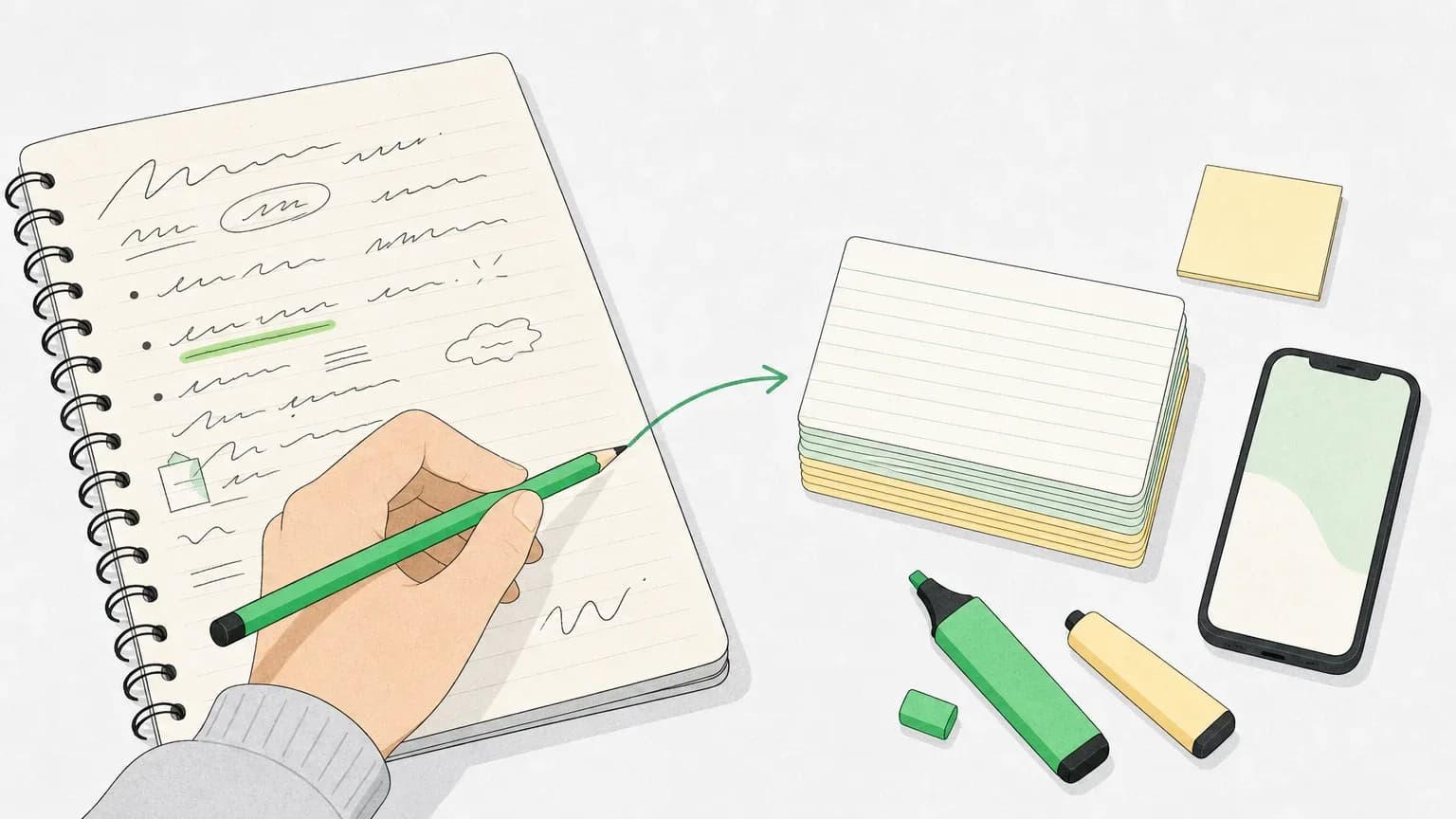
Neither replaces the other. Blurting is the wide, unaided pass that finds out what you have not learned; flashcards are the narrow, repeated pass that fixes it.
| Blurting | Flashcards | |
|---|---|---|
| Best for | A whole topic or chapter, early in learning it | One fact or idea at a time, reviewed on a schedule |
| Cue given | None; you supply the structure | A specific question |
| What it reveals | Gaps in your overall understanding | Whether one specific fact has stuck |
| Effort per pass | High; a few minutes per topic | Low per card, many cards per session |
| Good moment to use it | Once you finish a section, before making cards | Every day, on cards already made |
A practical order: read a section, blurt it before making anything, then turn the parts you missed into flashcards for the days after. The blurt finds the gaps; the cards close them on a schedule.
How to blurt in 4 steps
- Pick one bounded topic. A chapter, a lecture, a system in the body: something you could plausibly cover in one page, not a whole subject.
- Close everything and write. On a blank page or screen, write down everything you remember: definitions, examples, how things connect, in whatever order they come. Do not stop to check.
- Check against the source, in a different color or format. Compare your page to your notes. Mark what you got right, what you got wrong, and, most importantly, what you left out entirely.
- Turn the gaps into cards. Everything you missed becomes tomorrow’s flashcards or quiz questions. What you got right stays in rotation too; a single correct blurt is where retention starts, not where it ends.
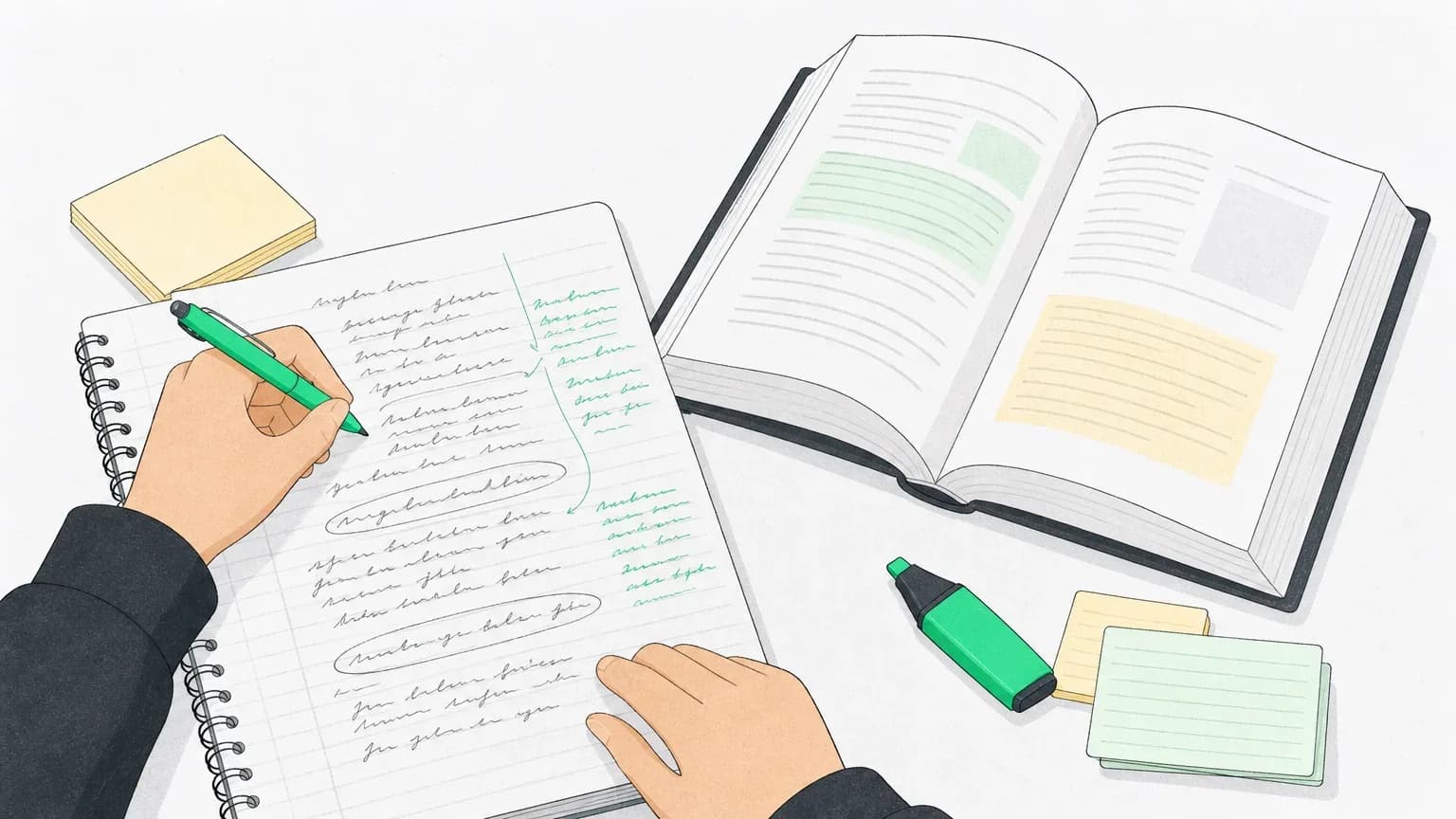
Blurt the whole topic in step 2 before splitting it into pieces. In a 2023 study of students with and without ADHD, recalling a whole text at once produced better recall two days later than recalling it section by section, even though the section-by-section group recalled more during practice itself.
Common blurting mistakes
- Peeking while you write. If your notes are open next to the blank page, you are copying, not blurting. Close everything first.
- Stopping at the first blank. A stall is data, not a stopping point. Write “I don’t remember this part” and move on, rather than quitting the page.
- Treating a good blurt as finished. A topic you blurted well today can fade in a week without another pass. Blurting once tells you what you know now; spaced review is what keeps it.
- Never doing it for anything you cannot outline. Blurting fits topics with structure: causes, steps, systems. For pure vocabulary or isolated facts, cued recall with flashcards is the better first tool.
- Skipping the color-coded check. Comparing your page to the source, and marking the misses clearly, is what turns the exercise into a study plan for tomorrow. Without it, blurting is just writing.
Blurting in Memrize
We make Memrize, so weigh this section accordingly. Blurting itself needs nothing but a blank page, and the app does not replace that part. What it does is the two steps around it: making the material to blurt from, and turning what you missed into a review that comes back on its own.
You give it a photo of your notes, a PDF, a recording or a pasted text, and it plans the material into testable units and writes a deck of cards for it. After you blurt a topic on paper, photograph the gaps or add a quick note, and Memrize can build cards from exactly what you missed rather than the whole chapter again.
3 in a row
 5
5 24
24New card
Which organelle produces most of a cell’s ATP?
Nice!
+7 XP · 3 in a row
ExplainFrom there it is the same system as any other card: reviews scheduled by FSRS toward 90% recall, formats that get harder as a card gets stronger, and a miss that comes back a few steps later instead of vanishing. The free plan keeps three decks at a time; Plus lifts the limits.
Sources
- Roediger, H. L., and Karpicke, J. D. (2006). Test-enhanced learning: Taking memory tests improves long-term retention. Psychological Science, 17(3), 249–255.
- Tulving, E., and Pearlstone, Z. (1966). Availability versus accessibility of information in memory for words. Journal of Verbal Learning and Verbal Behavior, 5(4), 381–391.
- Carpenter, S. K., and DeLosh, E. L. (2006). Impoverished cue support enhances subsequent retention: Support for the elaborative retrieval explanation of the testing effect. Memory & Cognition, 34(2), 268–276.
- Blunt, J. R., and Karpicke, J. D. (2014). Learning with retrieval-based concept mapping. Journal of Educational Psychology, 106(3), 849–858.
- Stern, C., and Halamish, V. (2023). Free-recall retrieval practice tasks for students with ADHD: whole-text versus section recall. Frontiers in Psychology, 14, 1301726.
Questions students ask
Is blurting the same as active recall?
Blurting is one specific way to do active recall: writing or saying everything you remember about a topic with nothing in front of you. Flashcards and practice questions are also active recall, but they give you a cue. Blurting gives you none, which is what makes it harder and, for finding gaps in a whole topic, more revealing.
Why do I remember less when I blurt than when I do a quiz?
A quiz question narrows the search for you; a blurt gives you no help at all. In a classic memory study, unaided recall of a list reached 40% while a cue for every item reached 75%. The memories were there; the cue made them reachable. An exam rarely gives that much help, so the blurt is the more honest measure.
How often should I blurt the same topic?
Once to find the gaps, right after you learn a section, and once again a few days later to see what stuck without the notes fresh in mind. After that, move the material into flashcards scheduled by spaced repetition, which reviews each fact again just before you would forget it, rather than reblurting the whole topic on a fixed schedule.