How to Memorize Something Fast: A One-Evening Method
On this page
- What is the fastest way to memorize something?
- Why does rereading feel fast but fail?
- How do you memorize something with active recall?
- How long should you leave between reviews?
- Does cramming ever work?
- Do memory palaces and other tricks help?
- How do you turn your notes into questions quickly?
- What is a 5-step plan to memorize something tonight?
- How to memorize fast in Memrize
- Sources
- Questions students ask
To memorize something fast, put it in your own words, turn it into short questions, and answer them from memory in two sittings with a real break between them. Words people produce themselves are remembered better than words they only read, an effect found across five experiments as long ago as 1978. A second sitting after a gap beats one long sitting of the same length. The quick-feeling option, reading the page again, is the one that fades first.
Key takeaways
- The quickest route is to answer from memory, not reread. Cover the answer, try, then check.
- Two short sittings with a gap between them beat one long sitting of the same total time.
- If the test is a week away, a gap of a day or two is about right. Closer tests need a shorter gap.
- Memory tricks like a memory palace work, but they are slow to set up. Use them for lists and order, not for ideas.
- Putting things into your own words and your own questions does more than copying the textbook.
What is the fastest way to memorize something?
Do three things, in this order: understand it well enough to say it in your own words, turn it into questions, and answer those questions from memory on at least two separate occasions.
That sounds slower than reading the chapter again, and for the first ten minutes it is. The payoff comes later. A review of ten popular study techniques by Dunlosky and colleagues (2013) rated only two as having high utility: practice testing and distributed practice, which means spreading study over time. Rereading, highlighting, summarizing, the keyword mnemonic and imagery for text all rated low.
So the fastest method is not a trick. It is the one that makes you do the work of remembering while there is still time to fix what you missed.
Why does rereading feel fast but fail?
Because a page you have just read is easy to recognize, and recognizing is not remembering. When the text is in front of you, everything looks familiar, and familiar feels like known.
Students misjudge this all the time. In Kornell’s 2009 flashcard experiments, most students remembered more when their study was spread across sittings, yet most of them believed the opposite after the first session, because the crammed cards felt fresh. The finals guide charts the numbers.
That is the trap with quick studying. The method that feels smooth in the moment is often the one that fades fastest. If a session feels a little hard, with answers you have to dig for, that is usually a sign it is working. The active recall guide goes through the research on this in detail.
How do you memorize something with active recall?
Close the notes, ask yourself a question, and answer it before you look. That is all active recall is. It is the first half of the fast method.
A quick version for a short list or a set of definitions:
- Read the material once, slowly enough to understand it.
- Cover it and say or write everything you remember.
- Open it and check. Mark what you missed.
- Cover it again and try only the missed items.
- Repeat until you get everything once without looking.
For a whole topic rather than a list, use blurting: write down everything you remember on a blank page, then fill in the gaps in a different color. The gaps are the part to spend your remaining time on.
How long should you leave between reviews?
As long as you can without forgetting most of it, and the right gap depends on when the test is.
Cepeda and colleagues (2008) taught more than 1,350 people a set of facts, gave them a review after different gaps, and tested them later. The best gap grew with the delay to the test. Measured against the delay, the best gap was about 20 to 40% of a one-week delay and about 5 to 10% of a one-year delay.
| Test is in | Best gap between sessions |
|---|---|
| About a week | Roughly 20 to 40% of the time left, so a day or two |
| About a year | Roughly 5 to 10% of the time left, so a few weeks |
The days are simple arithmetic on those percentages. The point is the shape: the further away the test, the longer the gap can be, but the gap is always a fraction of the time you have. A 2006 review of 317 experiments from 184 articles by the same group found the same pattern.
Does cramming ever work?
For a test in the next few minutes, rereading can keep you ahead. For almost anything else, it loses.
Kornell’s paper compared spreading study out with cramming it into the day before the test. Spacing was more effective. The 2006 review found the same thing across hundreds of experiments: when the delay to the test is long, material you studied in separate sittings is remembered better than the same time spent in one block.
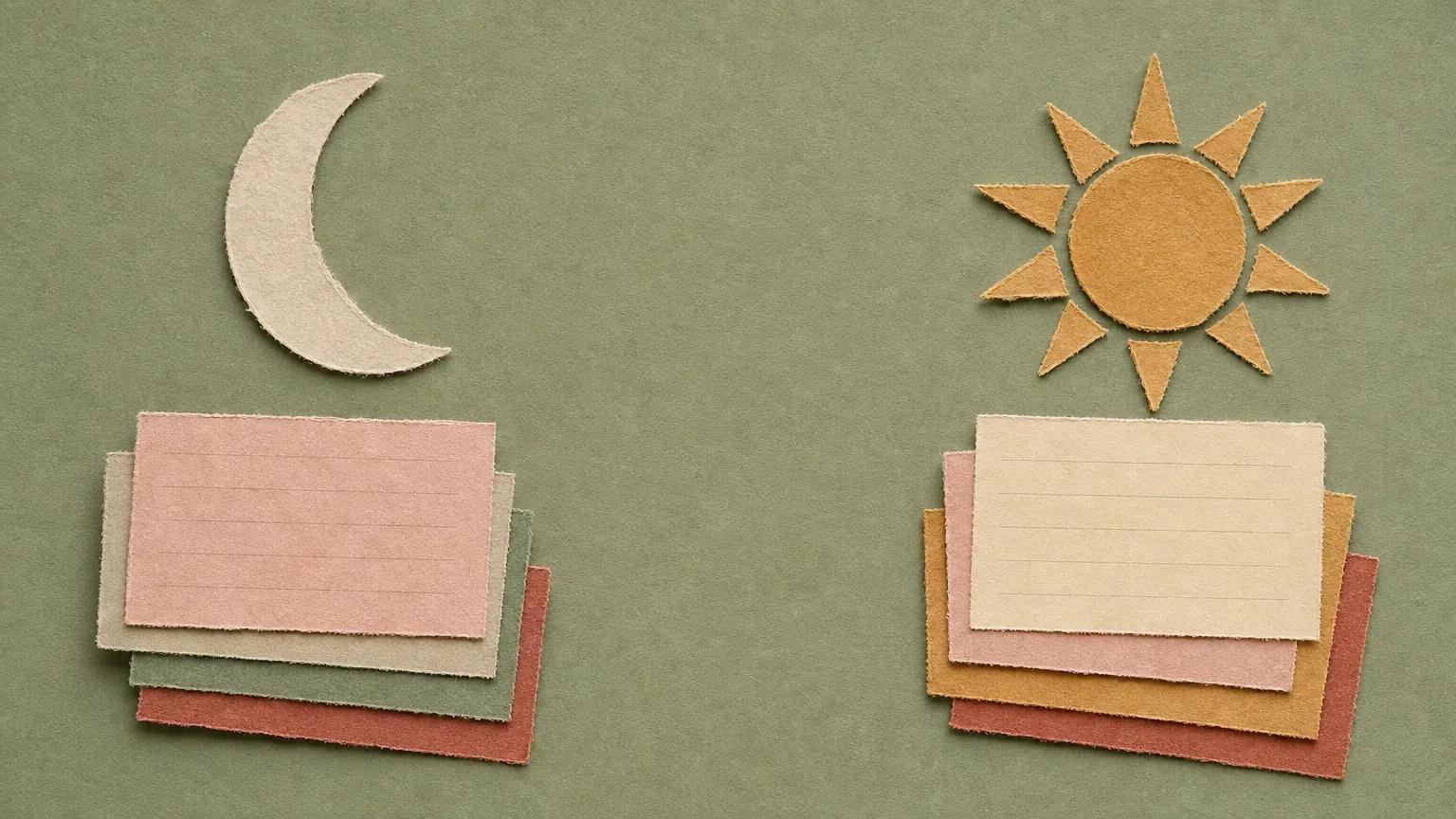
If cramming is all that is left, do it well. Skip the rereading, test yourself from the first minute, and split the time into at least two sittings with a real break between them, even if that break is just an hour.
None of that makes cramming a plan. It is damage control. If you have a choice of when to start, the biggest gain available is starting a day earlier.
Do memory palaces and other tricks help?
They can, for the right material. They are not the first thing to reach for.
The method of loci, or memory palace, pairs each item in a list with a place along a route you know well, such as your street. In a study by Dresler and colleagues (2017), volunteers who trained in the method for six weeks more than doubled the number of words they could recall from a list, and the gain was still visible four months later.
“Training normal humans to be memory athletes bulks up the brain’s memory networks.”
The catch is cost. The route takes time to learn and the pictures take time to build, and the 2013 review rated the keyword mnemonic low because it helps with a narrow range of material. Use a palace for an ordered list you must reproduce exactly, like the cranial nerves or the stages of a process. For ideas, causes and explanations, recall and spacing do the work.
How do you turn your notes into questions quickly?
Write the question in your own words, not the book’s. This is the part of studying that people skip, and it matters more than it looks.
Slamecka and Graf’s 1978 experiments gave the effect a name: the generation effect. Across five experiments, words that people produced themselves were remembered better than words they only read. Making the material yourself, even in a small way, makes it stick.
In practice:
- One fact per question. A question with a list of six answers will let you pass with four.
- Ask “why” and “how,” not only “what.” The answer then has to be explained, not just repeated.
- Put the question on one side and the answer on the other. Then test yourself with the answer hidden.
Writing good questions is also the slowest step. It is where an app can save you the most time, if it asks questions about your own material.
What is a 5-step plan to memorize something tonight?
This fits a single evening and uses everything above. Adjust the times to the amount of material.
- Minutes 0 to 10, understand. Read the material once and say each part in your own words. If you cannot, mark it and come back.
- Minutes 10 to 25, make questions. Turn each part into a short question with one answer. Skip anything you already know cold.
- Minutes 25 to 45, first round. Answer every question with the answer covered. Pull out the ones you missed.
- Break of at least 30 minutes. Do something else. The gap is what makes the second round work.
- Minutes 45 to 60, second round. Answer the missed ones first, then the rest. Anything missed twice gets a simpler question or an extra picture.
Then do round three tomorrow morning, before you look at anything. A second sitting on another day is the part that makes the first one last.
How to memorize fast in Memrize
We make Memrize, so weigh this section accordingly. It is built around the same two ideas, answering and spacing, and this describes what it does, not a promise about your results. How we write these guides is on our About page.
You give it your material: photos of your notes, a PDF, slides, pasted text or a lecture recording. It writes a deck of cards and several kinds of question for each one.
Then it runs the session:
- A new card is taught first, then asked two steps later, so the first answer comes from memory.
- A miss shows the explanation and returns five steps later in an easier format.
- Reviews are scheduled by FSRS, aiming for 90% recall.
- Set an exam date on a deck and it aims for 95% and paces the new cards so each one is met by the day before.
- Sessions are 5, 10 or 20 cards, so a round fits in a few minutes.
The free plan keeps three decks and makes up to three AI decks a day. Plus lifts those limits.
Sources
- Kornell, N. (2009). Optimising learning using flashcards: Spacing is more effective than cramming. Applied Cognitive Psychology, 23(9), 1297–1317.
- Cepeda, N. J., Pashler, H., Vul, E., Wixted, J. T., and Rohrer, D. (2006). Distributed practice in verbal recall tasks: A review and quantitative synthesis. Psychological Bulletin, 132(3), 354–380.
- Cepeda, N. J., Vul, E., Rohrer, D., Wixted, J. T., and Pashler, H. (2008). Spacing effects in learning: A temporal ridgeline of optimal retention. Psychological Science, 19(11), 1095–1102.
- Dunlosky, J., Rawson, K. A., Marsh, E. J., Nathan, M. J., and Willingham, D. T. (2013). Improving students’ learning with effective learning techniques. Psychological Science in the Public Interest, 14(1), 4–58.
- Dresler, M., Shirer, W. R., Konrad, B. N., Müller, N. C. J., Wagner, I. C., Fernández, G., Czisch, M., and Greicius, M. D. (2017). Mnemonic training reshapes brain networks to support superior memory. Neuron, 93(5), 1227–1235.
- Slamecka, N. J., and Graf, P. (1978). The generation effect: Delineation of a phenomenon. Journal of Experimental Psychology: Human Learning and Memory, 4(6), 592–604.
Questions students ask
What is the fastest way to memorize something?
Put it into questions, answer them from memory with the answers covered, and come back for a second round after a break. Practice testing and spreading study over time were the two techniques a 2013 review rated highest. Rereading and highlighting rated low, even though they feel quicker.
Can you memorize something in one night?
You can learn a lot in one evening if you test yourself instead of rereading and split the evening into at least two rounds with a break between them. What you cannot do is get the benefit of days of spacing. A second short sitting the next morning helps the first one last.
Is a memory palace worth learning for studying?
For ordered lists you must reproduce exactly, yes. In a 2017 study, six weeks of training in the method of loci more than doubled how many words people recalled. It takes time to build, though, and for ideas and explanations, recall practice and spacing are the better use of an evening.